

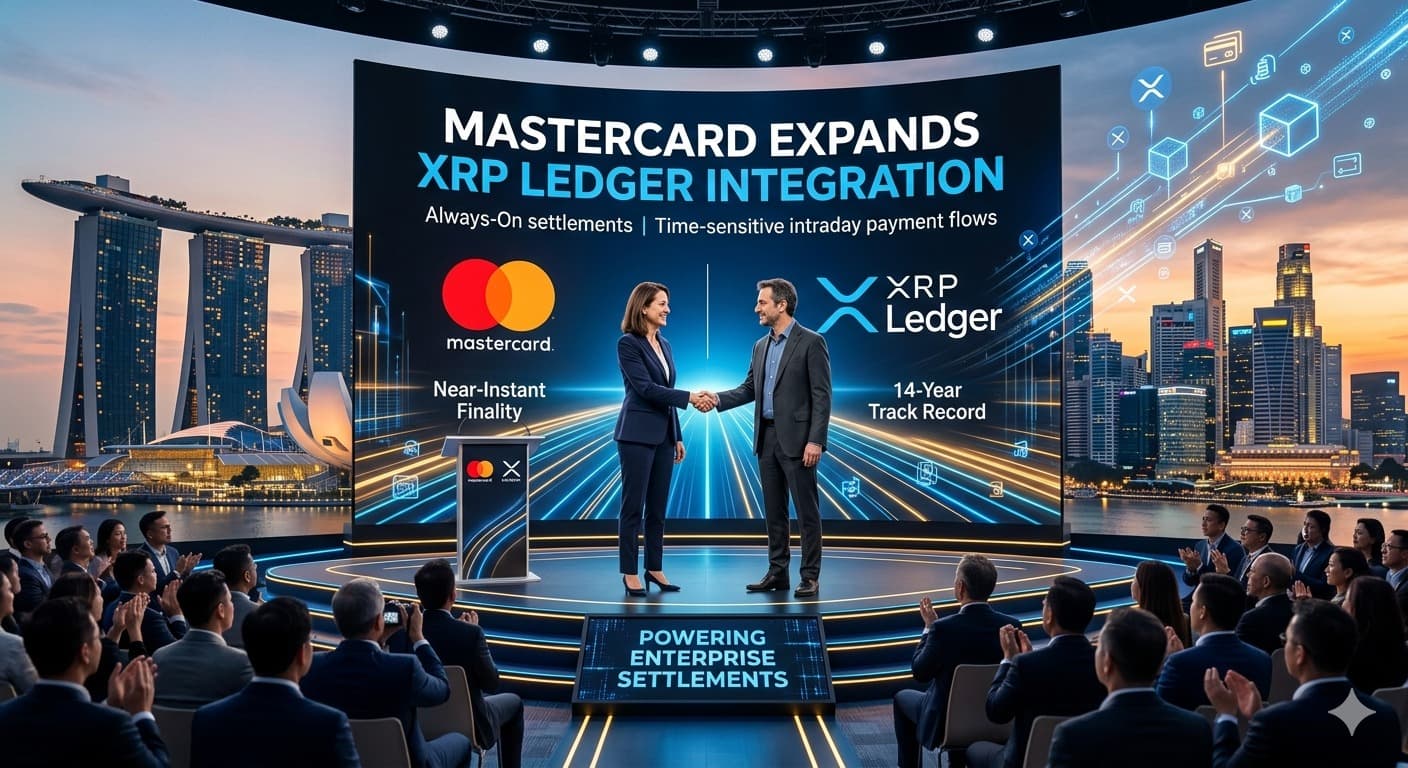
The corporate boundary lines separating legacy traditional financial institutions from decentralized public ledger technologies continue to collapse at an accelerating pace. In a landmark announcement shared by the XRP Ledger Foundation (@XRPLF), global payments network giant Mastercard is expanding its strategic integration with the XRP Ledger (XRPL). This ambitious operational expansion is explicitly engineered to facilitate always-on settlements and optimize time-sensitive intraday payment flows. As one of the world’s largest payment processors seeks to upgrade its core transactional capabilities, this move represents a major institutional shift, signaling a future where cross-border business settlement occurs in near real-time, completely free from the constraints of legacy banking hours.
The Technical Superiority of the XRP Ledger Integration
Mastercard’s decision to deepen its operational alignment with the XRP Ledger is rooted in structural market realities. To handle immense global enterprise volume, a payments network cannot afford to rely on unproven networks or highly volatile transaction fee structures. The XRP Ledger offers a compelling mix of core technical features: near-instant transactional finality (typically settling in 3 to 5 seconds), highly predictable sub-penny transaction costs, and a battle-tested 14-year operational track record.
CRYPTOCAP:TOTAL Real-Time Chart
For a financial titan managing billions of daily transactions, these technical attributes are entirely non-negotiable. Traditional settlement mechanisms are fundamentally analog, built upon legacy clearing houses that shut down during weekends, evenings, and bank holidays. By leveraging the XRPL’s distributed consensus architecture, Mastercard can execute automated, cryptographic clearings at any second of any day. This technical pivot ensures that liquidity can be routed dynamically to service high-velocity intraday payment flows without encountering the traditional frictions of international correspondent banking networks.
Overcoming the Corporate Liquidity Bottleneck
In the world of multinational treasury operations, capital efficiency is closely tied to settlement velocity. When a global payment processor coordinates transactions across multiple fiat currencies and jurisdictions, enormous pools of capital must sit idle in pre-funded accounts around the world. These stagnant funds act as collateral to guarantee settlement across lagging traditional settlement cycles.
 Brian Armstrong Rallies Crypto Voters as Pressure Mounts on Senate Leadership to Pass the CLARITY Act→
 Solana Redefines Capital Architecture: Delivering Markets That Never Close with Superior Execution→
 SEC Delivers Landmark Small Business Report to Congress: A Blueprint for Capital-Raising Policy Overhaul→
 Solana Spot Volume Now Beats Every CEX But One – and the Number Keeps Growing→
The Financial Friction of Legacy Systems
The operational limitations of legacy banking infrastructure become painfully obvious during periods of high market volatility or intense commercial activity. When international commercial partners cannot settle claims immediately, they face compounding counterparty risks and substantial opportunity costs. Large-scale financial clearings require instant adjustments. By modernizing its approach to intraday payment flows, Mastercard can drastically minimize these pre-funding requirements.
Unlocking Trapped Capital via Always-On Architecture
Transitioning to an always-on settlement architecture completely alters the corporate balance sheet. Instead of keeping millions of dollars trapped in stagnant accounts globally, companies can utilize the near-instant finality of the XRPL to move capital exactly when and where it is required. This real-time liquidity distribution model means that money is freed up to generate yield or fund active corporate initiatives, demonstrating the profound macroeconomic value of optimizing intraday payment flows.
Expert Opinions: Structural Integration vs. Free-Market Disruption
The expanding partnership between Mastercard and the XRP Ledger Foundation has drawn widespread analysis from fintech strategists, institutional asset managers, and monetary policy experts. To understand the long-term impact of this development, it is necessary to examine the divergent perspectives within the broader financial ecosystem.
The Institutional Bull Case for Enterprise Blockchains
Fintech infrastructure analysts largely view this expanded integration as an absolute game-changer for enterprise Web3 adoption. Experts emphasize that Mastercard’s choice to build directly on the XRPL validates the thesis that enterprise-grade public blockchains are uniquely positioned to handle institutional money. According to industry consensus, when a conservative, highly regulated payments giant utilizes decentralized infrastructure to process crucial intraday payment flows, it de-risks the entire blockchain sector for corporate treasurers worldwide who were previously hesitant to interact with digital assets.
Concerns Over Corporate Co-Optation of Decentralized Networks
Conversely, some decentralized network purists and alternative layer-1 advocates express a more cautious viewpoint. They warn that as multi-billion-dollar corporations integrate deeply into public ledgers, the nature of network governance and usage could shift. Critics argue that while the XRPL is inherently decentralized, heavy reliance on the network by massive centralized entities like Mastercard might lead to institutional pressure regarding feature prioritization or fee adjustments. Nonetheless, even conservative critics acknowledge that using the XRPL to manage intraday payment flows proves that legacy payment rails are structurally deficient compared to distributed ledgers.
Transatlantic Regulatory Realities and the Blockchain Race
Mastercard’s aggressive push into public ledger infrastructure does not occur in a regulatory vacuum. This development arrives amid a broader, coordinated effort by international watchdogs to establish clear legal boundaries for digital assets and tokenized payment instruments. We have already seen major payment players reposition themselves globally, as highlighted by our previous analysis of Mastercard’s historic $1.8 billion crypto infrastructure buy, which demonstrated a clear corporate mandate to dominate the next-generation settlement layer.
For a payment giant to confidently process intraday payment flows on a public blockchain, it requires ironclad jurisdictional clarity. This operational necessity explains why institutional players are paying close attention to landmark legislative frameworks across the West. For instance, the progress seen with the Senate Banking Committee passing the Clarity Act provides the concrete legal parameters required for corporate entities to issue and settle tokenized dollar liabilities safely inside the United States.
Without this evolving regulatory scaffolding, major payment processors would be unable to scale their on-chain operations. When legacy networks move too slowly to embrace these modernized rails, they risk ceding their monetary sovereignty entirely. This structural threat is evident in recent policy debates within the Eurozone, where central bankers have issued stark warnings regarding the rising threat of digital dollarisation in Europe due to a distinct lack of agile, public digital currency options.
Macroeconomic Implications for Institutional Capital Flows
The broader macroeconomic trajectory of digital assets is fundamentally shifting from speculative retail trading toward permanent, institutional infrastructure integration. As enterprise giants construct the necessary pipelines to route intraday payment flows seamlessly across decentralized networks, the entire financial ecosystem undergoes a dramatic re-pricing of risk and utility.
This structural evolution aligns seamlessly with broader institutional patterns observed across the macro landscape. As traditional payment networks modernize their infrastructure, macro funds are shifting their allocations to capture digital scarcity. This trend is clearly visible in the market-wide adoption of Michael Saylor’s Bitcoin accumulation models by corporate treasuries seeking a reliable hedge against fiat debasement.
Furthermore, the institutionalization of on-chain payments coincides with a growing geopolitical interest in alternative reserve assets. Whether tracking the rapid legislative momentum behind the US Strategic Bitcoin Reserve bill or analyzing the macroeconomic structural incentives driving why central banks will buy Bitcoin, the message is uniform: hard digital money and efficient digital rails are the core pillars of future economic dominance.
As financial outlets continue to popularize aggressive long-term valuation models, such as the Bitcoin $1 million prediction discussed on CNBC, the foundational infrastructure being deployed by Mastercard ensures that the real-world liquidity channels are fully built out to support unprecedented transactional scale. The optimization of intraday payment flows via the XRP Ledger is a critical step forward in this structural financial transition.
CRYPTOCAP:TOTAL Real-Time Chart
Conclusion: The Era of Instant Settlement
Ultimately, the expanded integration between Mastercard and the XRP Ledger proves that the future of global commerce belongs to always-on, real-time financial networks. By moving away from the frictional constraints of legacy banking hours and embracing the proven 14-year track record of the XRPL, Mastercard is safeguarding its position at the apex of global payments. The ability to seamlessly coordinate high-velocity intraday payment flows across decentralized architecture marks the definitive end of the analog financial era, ushering in a synchronized global economy built directly on the blockchain.