

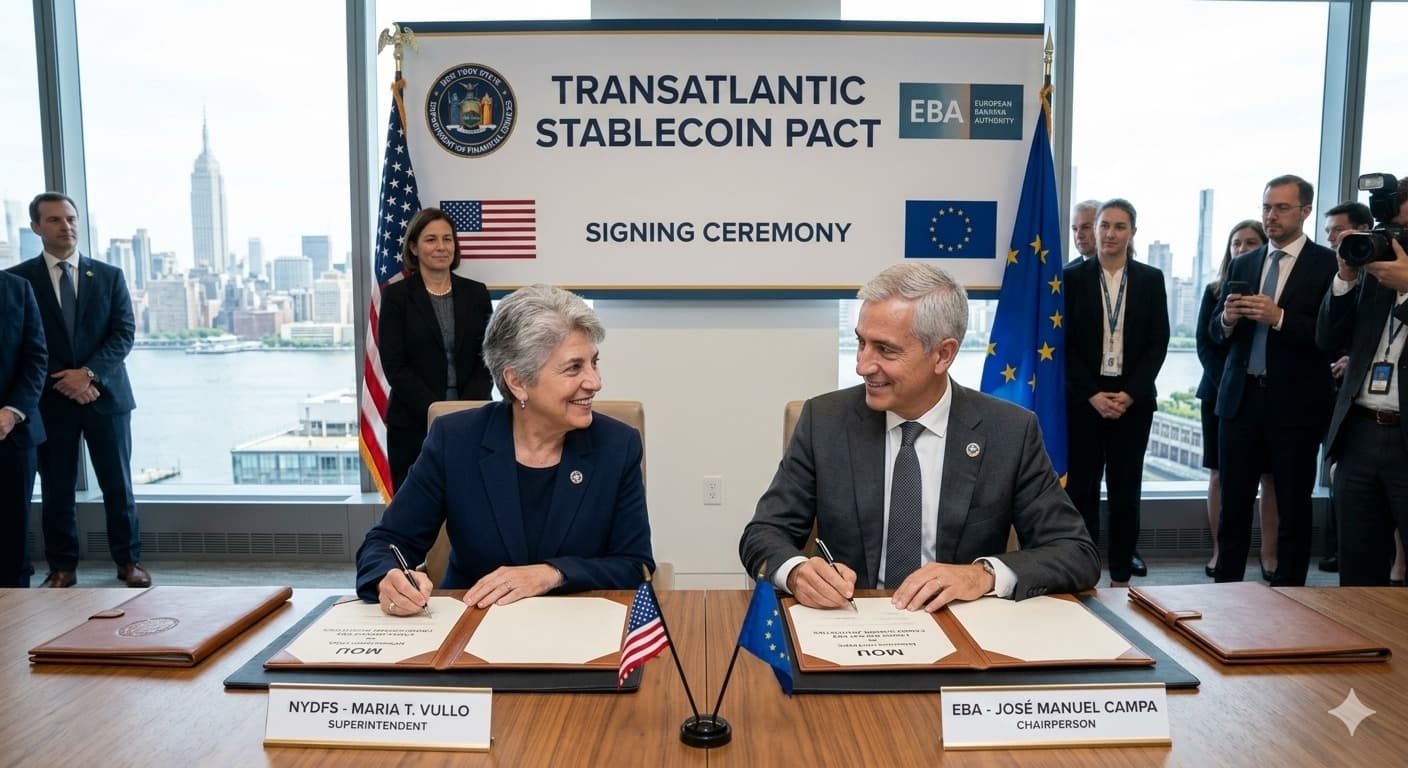
The global digital asset ecosystem has reached an unprecedented regulatory milestone, signaling a new era of cross-border institutional oversight. The New York State Department of Financial Services (NYDFS) signed a historic Memorandum of Understanding (MOU) with the European Banking Authority (EBA). This agreement establishes a formal, coordinated framework specifically designed to facilitate the exchange of supervisory information and enhance oversight of cross-border stablecoin activities.
As digital fiat tokens transition from niche speculative instruments into core utilities for global remittance and enterprise treasury settlements, the world’s most sophisticated regulators are closing ranks. This transatlantic alignment marks a major shift from localized enforcement toward a unified, international approach to crypto-asset compliance.
CRYPTOCAP:TOTAL Real-Time Chart
The Core of the NYDFS-EBA Alliance
The newly formed alliance between the NYDFS and the EBA represents a structural bridge between two of the most influential regulatory regimes in the world. New York has long been considered a premier jurisdiction for digital asset oversight in the United States, utilizing its strict stablecoin supervisory framework since 2018. Meanwhile, the European Banking Authority operates as a central supervisory anchor for the European Union’s landmark Markets in Crypto-Assets (MiCA) regulation.
By formalizing this partnership, both regulatory bodies aim to map out emerging systemic risks and align their data-sharing practices. According to the official press release issued by the New York State Department of Financial Services, the arrangement is strictly focused on supervising the stablecoin-related operations of multinational institutions, ensuring that information exchange does not disrupt broader banking activities. This targeted focus allows regulators to closely monitor how dollar-denominated and euro-denominated tokens circulate globally, offering unprecedented transparency into cross-border stablecoin activities.
 Cross River Brings RLUSD Into Core Banking→
 MoneyGram Joins XDC Network as Institutional Validator→
 Mastercard and BVNK have launched a new global payments platform→
 Fink: Data Center Moratorium Risks Recession→
Bridging New York Regulations and MiCA
To appreciate the significance of this agreement, it is essential to look at the structural mechanics of how both jurisdictions manage digital fiat assets. The NYDFS enforces strict requirements that mandate stablecoin issuers to maintain 100% backing in highly liquid reserves, execute daily disclosures, and completely ban the rehypothecation of reserve assets. On the other side of the Atlantic, MiCA establishes a rigid framework for asset-referenced tokens (ARTs) and e-money tokens (EMTs), demanding robust governance and consumer protection standards.
Breaking Down the Supervisory Alignment
The cooperation pact is built upon several core operational pillars intended to streamline the monitoring of cross-border stablecoin activities:
- Information Reciprocity: Real-time exchange of supervisory and confidential data regarding multinational issuers operating simultaneously in New York and the EU.
- Trend and Risk Identification: Collective macroprudential monitoring to spot liquidity imbalances, reserve allocation vulnerabilities, or systemic de-pegging risks before they threaten market stability.
- Protecting Consumer Integrity: Aligning safety and redeemability standards to ensure that retail and institutional token holders have guaranteed rights to convert their digital assets back to fiat, regardless of jurisdiction.
This operational harmony ensures that large-scale stablecoin issuers can no longer exploit regulatory arbitrage by shifting corporate entities across borders. Instead, any compliance deviation flagged by the NYDFS in New York can be instantly communicated to European regulators under the MiCA framework, creating a standardized compliance loop.
Expert Opinions: Market Efficiency vs. Bureaucratic Friction
The signing of the MOU has sparked intense debate among fintech lawyers, macroeconomists, and digital asset policy strategists. While the industry broadly welcomes regulatory clarity, opinions remain divided on how this coordination will affect the speed of private sector innovation.
EXPERT CONSENSUS ON THE REGULATORY PACT
Institutional Trust Standardized compliance de-risks digital
assets for conservative corporate funds.
Innovation Velocity Strict oversight could slow down the
deployment of next-gen smart contracts.
Arbitrage Reduction Eliminates regulatory gaps between major
Western financial jurisdictions.
The Case for Institutional Standardization
Many compliance officers and enterprise treasury experts view the agreement as a vital catalyst for institutional adoption. When major global watchdogs collaborate openly, it builds an immutable layer of trust for conservative financial players. Expert opinions suggest that a transparent, coordinated framework removes the lingering fear of sudden regulatory crackdowns. With clear guidelines governing cross-border stablecoin activities, global enterprises can safely build automated, multi-jurisdictional payment pipelines without worrying about sudden legal shifts.
Concerns Over Regulatory Fragmentation
Conversely, some decentralization advocates and crypto-native legal scholars urge caution. They argue that applying multi-layered, state-level supervision to decentralized protocols could inadvertently stifle the growth of decentralized finance (DeFi). Critics point out that if the exchange of confidential data between the EBA and NYDFS leads to heavy-handed enforcement on non-custodial, algorithmic protocols, it could drive innovation completely out of Western economies. Experts emphasize that the core strength of blockchain technology lies in its borderless nature, meaning that excessive friction on cross-border stablecoin activities might cause liquidity to migrate toward less restrictive, offshore jurisdictions.
Macro Implications for Capital Flows and Sovereign Money
The broader macroeconomic impact of this alliance extends far beyond basic compliance. For years, European central bankers have expressed concerns over the rapid expansion of private, USD-denominated stablecoins across their local markets. This phenomenon has triggered deep internal debates regarding the loss of monetary autonomy. We have observed these concerns intensifying on a global scale, highlighted by previous warnings from European leaders about the growing risk of digital dollarisation in Europe, where highly liquid digital dollars threaten to outpace localized public digital infrastructure.
By forming a direct supervisory partnership with the NYDFS, the EBA can better manage the integration of dollar tokens within its borders while ensuring that euro-backed stablecoins are afforded the same level of institutional support and security. This transatlantic regulatory balancing act arrives as parallel legislative efforts in Washington continue to move forward, most notably with the Senate Banking Committee passing the Clarity Act, which aims to establish a permanent federal framework for stablecoin issuance inside the United States.
Furthermore, as the plumbing of traditional finance adopts stablecoin settlement, the macro trajectory for scarce digital assets shifts. The institutionalization of digital fiat networks provides the foundational infrastructure needed to handle massive capital inflows. As governments formalize rules for digital currencies, it naturally paves the way for deeper exploration of alternative sovereign reserves. Whether analyzing state-level plans like the newly proposed US Strategic Bitcoin Reserve bill or observing how central banks are structurally incentivized to buy Bitcoin to hedge against broader currency debasement, the underlying trend remains identical: the digitization of global money is an unstoppable evolution.
The Path Forward for Multinational Issuers
Ultimately, the agreement signed by NYDFS Acting Superintendent Kaitlin Asrow and EBA Chair François-Louis Michaud proves that global stablecoin supervision is no longer a localized issue. For multinational fintech firms, the strategy is clear: compliance can no longer be an afterthought or a localized patch. To thrive in the evolving landscape of cross-border stablecoin activities, builders must design their architectures to meet the highest common denominator of regulatory scrutiny.
CRYPTOCAP:TOTAL3 Real-Time Chart
As mainstream financial broadcasters continue to popularize aggressive long-term valuation models, including the Bitcoin $1 million prediction discussed on CNBC, the construction of bulletproof, regulated fiat on-and-off ramps becomes the ultimate bridge for global capital. The NYDFS and EBA alliance ensures that those bridges are securely built, tightly monitored, and fully integrated into the future of international finance.