

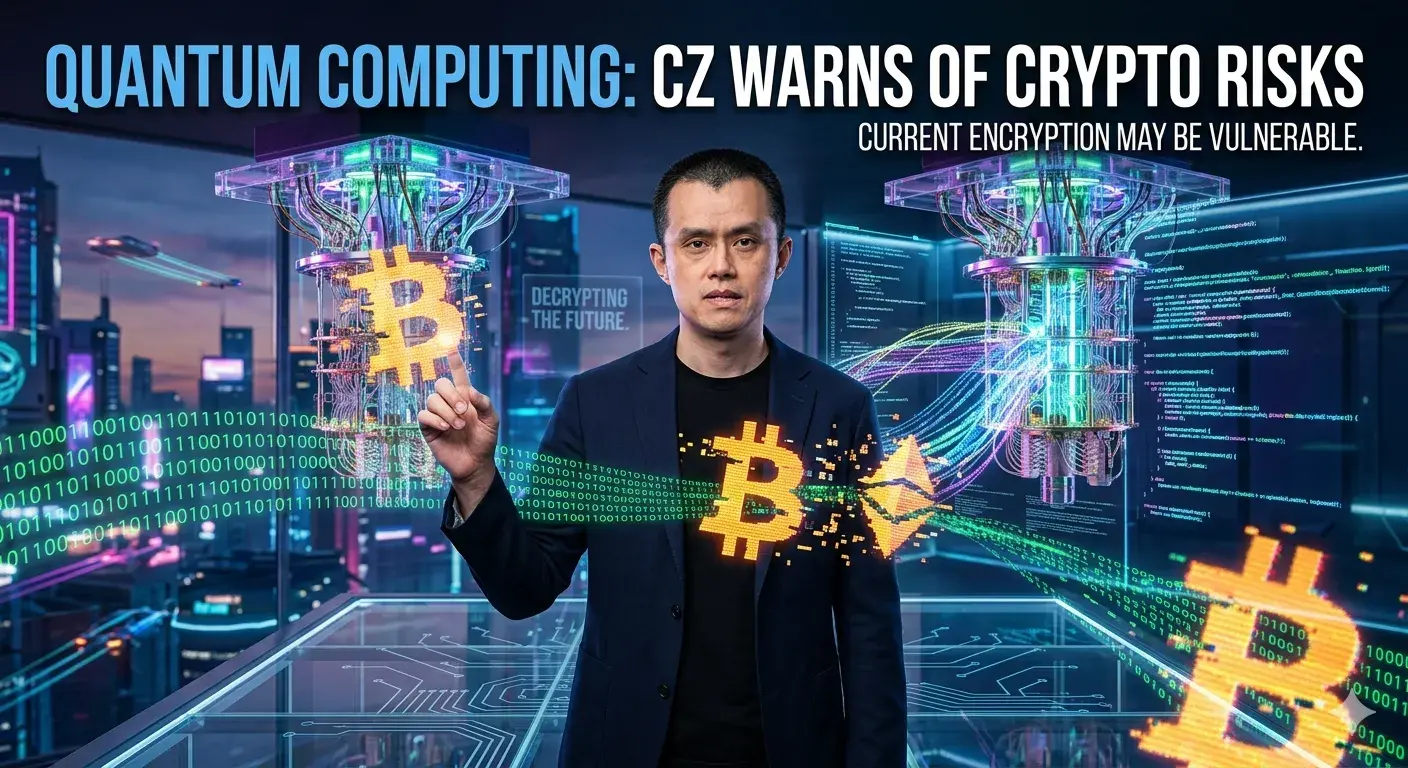
The digital asset landscape was recently jolted by a stark warning from one of the industry’s most influential figures. Changpeng Zhao (CZ), the founder of Binance, took to social media to highlight a looming technological shadow: the advent of quantum computing and its potential to dismantle the cryptographic foundations of the blockchain.
In a concise but urgent message, CZ stated that quantum computing may break existing encryption, suggesting that the time for Bitcoin to undergo a significant upgrade is no longer a distant theoretical discussion, but a pressing necessity. As the “Q-Day”—the hypothetical point where quantum computers can crack modern encryption—approaches, the community is forced to ask: Is the quantum computing crypto threat being taken seriously enough?
CRYPTOCAP:TOTAL Real-Time Chart
The Mechanics of the Warning: Why Encryption is Vulnerable
To understand why CZ’s warning carries such weight, one must look at the mathematical bedrock of Bitcoin. Currently, Bitcoin and the vast majority of cryptocurrencies rely on the Elliptic Curve Digital Signature Algorithm (ECDSA). This system ensures that only the person with the private key can authorize a transaction.
Under classical computing conditions, it would take trillions of years to “guess” a private key. However, quantum computers operate on qubits, allowing them to perform complex calculations at speeds unimaginable to traditional processors. Specifically, Shor’s Algorithm—a quantum algorithm developed in 1994—has the theoretical capability to solve the discrete logarithm problem that secures ECDSA.
 Congress Demands SEC Answers on Agentic AI Trading: What It Means for Retail Investors→
 Momentum Builds for US Crypto Regulation: Senate Banking Committee Passes Clarity Act→
 Big Blue’s Big Bet: IBM Launches Institutional Wallet for 97 of the Top 100 Banks→
 Jamie Dimon’s Global Pivot: Why the “Experiment” Phase is Over for Crypto→
If a sufficiently powerful quantum computer is built, the quantum computing crypto threat could allow bad actors to derive private keys from public addresses, potentially compromising billions of dollars in “cold” wallets that have not moved funds in years.
Expert Opinions: A Race Against Time
The consensus among analysts and cryptographers is divided between urgency and cautious optimism.
Vitalik Buterin, co-founder of Ethereum, has previously addressed this concern, suggesting that the industry is already preparing. Buterin noted that a “simple” hard fork could theoretically protect a network. He proposed that if a quantum attack were detected, the network could revert to a point before the attack and implement a new signature scheme that is quantum-resistant.
Andreas Antonopoulos, a renowned Bitcoin educator, has often argued that Bitcoin is not a static protocol. He maintains that Bitcoin’s greatest strength is its ability to reach consensus on upgrades. “Bitcoin will simply adopt post-quantum cryptography (PQC) when the threat becomes measurable,” Antonopoulos has stated in various technical forums.
However, Vivek, a prominent market analyst whose data source sparked this recent discussion, emphasizes the “fire” (urgency). He suggests that the transition to post-quantum standards needs to happen before the hardware exists, not after.
The Roadmap for a Quantum-Resistant Bitcoin
Upgrading Bitcoin is not as simple as a software update on a smartphone. It requires a massive consensus among miners, developers, and node operators. Several paths are currently being explored by the global cryptographic community:
- Lamport Signatures: An older but effective method of creating one-time signatures that are theoretically resistant to quantum attacks.
- Winternitz One-Time Signatures (WOTS): A more efficient version of Lamport signatures that could be integrated into the Bitcoin protocol.
- Lattice-based Cryptography: This involves complex multi-dimensional algebraic structures that even quantum computers struggle to solve.
The quantum computing crypto threat is particularly dangerous for “Satoshi-era” coins—wallets that haven’t been active for a decade. These wallets use older P2PK (Pay to Public Key) formats where the public key is already exposed on the ledger. Modern P2PKH (Pay to Public Key Hash) addresses are slightly safer until the first time a transaction is sent from them.
NIST and the Global Standard
It isn’t just the crypto world that is worried. The National Institute of Standards and Technology (NIST) has been running a multi-year competition to find and standardize post-quantum cryptographic algorithms. This shows that the quantum computing crypto threat is a matter of national and global security, affecting everything from banking to military communications.
For site owners and developers at CryptoQuorum, it is essential to realize that Bitcoin’s evolution toward quantum resistance will likely be the most significant “hard fork” or “soft fork” in the history of the network.
Will the Market React?
Historically, the crypto market reacts to immediate threats (regulatory crackdowns, exchange hacks) rather than long-term technical hurdles. However, as quantum prototypes from companies like IBM and Google continue to hit new qubit milestones, the “Quantum FUD” (Fear, Uncertainty, Doubt) may begin to impact long-term valuation models for Bitcoin as a “Store of Value.”
If Bitcoin proves it can successfully transition to a post-quantum standard without losing its decentralized nature, it will likely solidify its position as the world’s most secure financial network.
Conclusion: The Future is Post-Quantum
CZ’s warning serves as a vital reminder: technology never stands still. The quantum computing crypto threat is a reminder that the “set it and forget it” mentality doesn’t apply to the underlying code of the financial future. Bitcoin was built to survive. Whether through Schnorr signatures or future lattice-based upgrades, the network must evolve to remain the “digital gold” it is touted to be.
As the industry matures, expect to see more “Post-Quantum” labels on new blockchain projects. For now, the eyes of the world are on Bitcoin’s core developers to see how they will answer the quantum challenge.
Is your portfolio ready for the next era of digital security? Stay informed on the latest technical upgrades by subscribing to our newsletter.
Disclaimer
The information in this article is for informational and educational purposes only and does not constitute financial, investment, or legal advice. Cryptocurrency investments carry a high degree of risk and volatility.
The discussion regarding quantum computing and its impact on encryption is based on theoretical projections and current industry sentiment. Always conduct your own research (DYOR) and consult with a professional financial advisor before making any investment decisions. CryptoQuorum assumes no responsibility for any financial losses resulting from the use of this information.