

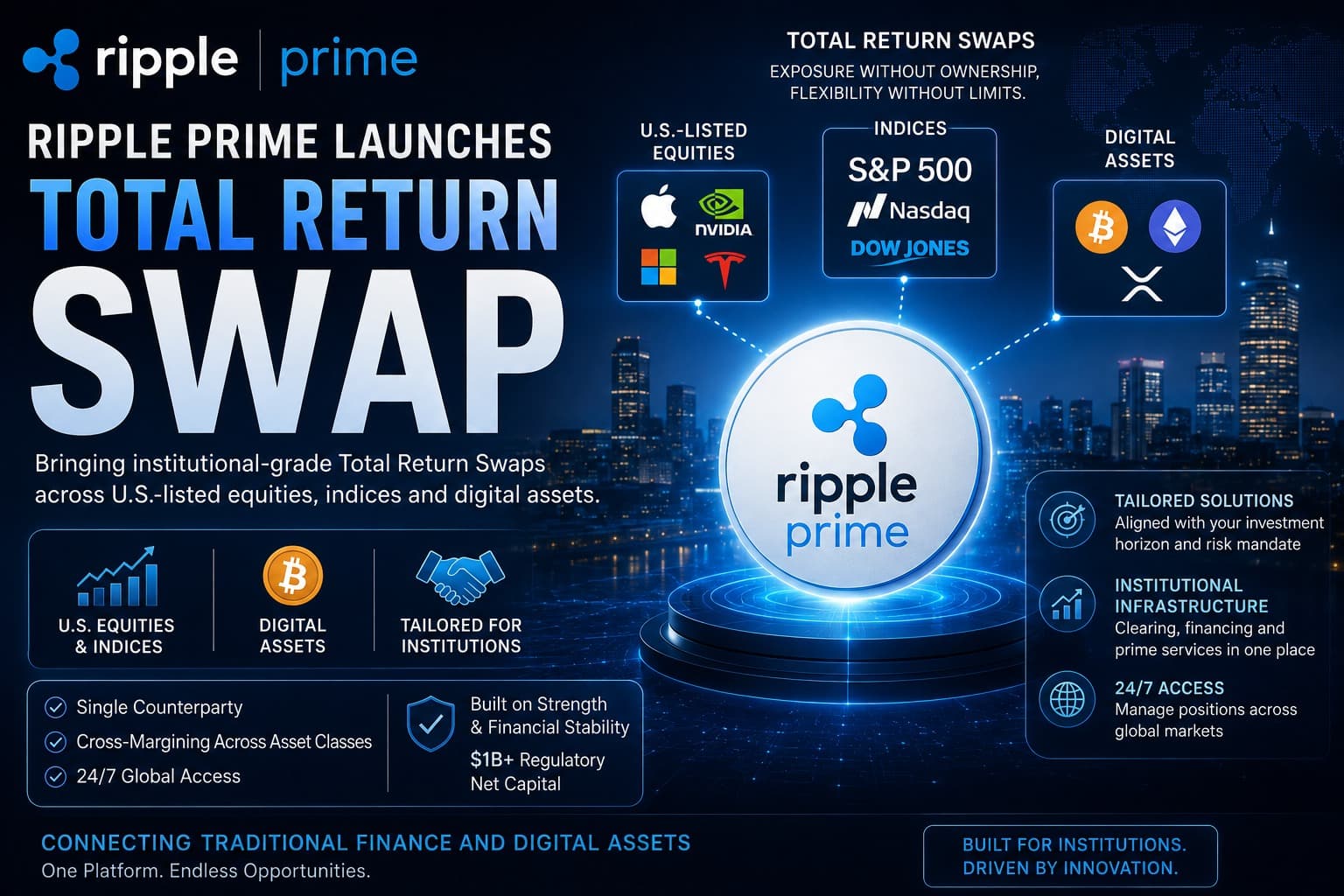
Ripple is taking another major step into institutional finance with the launch of Delta One, a new business within Ripple Prime that enables institutional clients to execute Total Return Swaps across U.S.-listed equities, indices and digital assets.
The new service went live on August 27, 2026, and is designed for hedge funds, asset managers and other financial institutions with different investment horizons, risk mandates and reporting requirements. Ripple says the offering combines equity derivatives with its existing prime brokerage, clearing and financing capabilities across foreign exchange, fixed income, derivatives and digital assets.
CRYPTOCAP:TOTAL3 Real-Time Chart
The development is important because Ripple Prime is no longer positioning itself primarily as infrastructure for digital-asset trading. It is building a multi-asset institutional platform capable of connecting traditional markets and digital assets through one prime brokerage relationship.
That strategy could put Ripple Prime into more direct competition with established institutional financial firms.
 Mastercard joins XRP Ledger Hackathon ahead of Ripple Swell→
 RLUSD Crosses $2B as Ripple Expands Enterprise Stablecoin Strategy→
 Phantom to Discontinue Support for Sui on September 24: Safe Migration Guide for Wallet Holders→
 EU Opens Targeted MiCA Regulation Review as Non-Custodial DeFi Vaults Reshape On-Chain Yield→


6
What are Total Return Swaps?
A Total Return Swap is a derivative contract that allows one party to receive the economic performance of an underlying asset without directly owning that asset.
The return can include changes in the asset’s price as well as other economic components such as dividends or distributions. In exchange, the other side typically receives a financing-related payment based on an agreed rate or benchmark.
For an institutional investor, the structure can provide exposure to a stock, index or digital asset without requiring the fund to purchase and hold the underlying instrument directly.
That can be useful for institutions managing:
- portfolio exposure;
- leverage;
- hedging strategies;
- capital efficiency;
- financing;
- short or long positions;
- cross-asset risk.
The important distinction is that a swap creates economic exposure, not necessarily direct ownership of the underlying asset.
This makes the product particularly relevant to professional investors that already operate sophisticated derivatives and risk-management programs.
Ripple Prime’s single-counterparty model
Ripple’s central pitch for Delta One is consolidation.
Clients can access equities, FX, derivatives, fixed income and digital assets through a single counterparty while cross-margining exposures across supported asset classes.
Ripple says the platform operates around the clock, allowing institutional clients to manage positions across traditional and digital markets within the same framework.
This is potentially significant for firms that currently maintain multiple prime-brokerage relationships.
Consider a hedge fund with exposure to:
- U.S. technology stocks;
- equity indices;
- Bitcoin;
- XRP;
- FX;
- fixed-income instruments.
Managing those positions across different counterparties can create fragmented collateral, separate reporting processes and additional operational complexity.
A multi-asset prime broker can potentially reduce some of that fragmentation.
Ripple Prime’s Delta One model
| Feature | What Ripple Prime is offering |
|---|---|
| Asset classes | U.S. equities, indices and digital assets |
| Product | Total Return Swaps |
| Target clients | Hedge funds, asset managers and financial institutions |
| Counterparty structure | Single prime-broker relationship |
| Margin | Cross-margining across supported assets |
| Availability | 24/7 |
| Execution model | Clearing and financing-focused |
| Capital | More than $1 billion in regulatory net capital |
The figures and product characteristics above are based on Ripple’s August 27 announcement.
Why the “Delta One” label matters
The term Delta One is well established in institutional markets.
Delta measures the sensitivity of a derivative’s value to changes in the underlying asset. A product with a delta close to one is designed to track the underlying asset’s price movement relatively closely.
Traditional investment banks have operated Delta One desks for years, offering products such as swaps, futures and other instruments that provide synthetic exposure to stocks and indices.
Ripple Prime is therefore entering a market with an established institutional vocabulary and business model.
The strategic difference is its attempt to combine that traditional market infrastructure with digital assets.
That cross-asset positioning could become one of the company’s most important competitive advantages if institutional demand for crypto and traditional assets continues to converge.
A bridge between Wall Street and digital assets
Ripple’s expansion should be viewed in the context of its acquisition of Hidden Road.
In April 2025, Ripple announced its $1.25 billion acquisition of Hidden Road, describing the company as a global multi-asset prime broker providing clearing, financing and prime brokerage across FX, digital assets, derivatives, swaps and fixed income. Hidden Road had more than 300 institutional customers and was clearing approximately $3 trillion annually at the time of the announcement.
The acquisition subsequently closed, and Hidden Road became Ripple Prime.
Ripple said the business had grown threefold from the time the acquisition was announced through the closing of the transaction.
That acquisition effectively gave Ripple something that would have been difficult to build from scratch: an existing institutional trading, clearing and financing platform.
The Delta One launch demonstrates how Ripple is now using that infrastructure to expand into additional asset classes.
Ripple Prime is building a broader institutional stack
Delta One is not an isolated product launch.
Over the past year, Ripple Prime has continued expanding its institutional infrastructure.
In November 2025, Ripple launched U.S. digital-asset spot prime brokerage capabilities, allowing institutional clients to execute OTC transactions across major digital assets, including XRP and RLUSD.
In May 2026, Ripple Prime integrated with EDX Markets, providing institutional clients with access to EDX spot and perpetual-futures liquidity through its prime-brokerage framework.
The same month, Ripple Prime secured a $200 million debt facility from funds managed by Neuberger Specialty Finance to support its growth and margin-financing capabilities.
Then, on August 18, Ripple Prime announced an upsized $275 million private placement of senior unsecured notes. Ripple said the proceeds would support working capital and general corporate purposes within its regulated prime-brokerage business. The notes received a BBB investment-grade rating from KBRA.
Together, these developments show a clear pattern:
Ripple is building capital, liquidity and financing infrastructure around a multi-asset institutional business.
More than $1 billion in regulatory net capital
The balance sheet is another important part of the Delta One story.
Ripple says Ripple Prime has more than $1 billion in regulatory net capital, providing a substantial capital base for its expansion into equity derivatives.
For institutional derivatives clients, counterparty strength is critical.
A derivative contract is ultimately a bilateral financial obligation. The ability of the counterparty to meet its obligations is therefore an important part of the risk assessment.
That is one reason institutional investors perform extensive due diligence on prime brokers, including reviews of:
- regulatory status;
- capital;
- liquidity;
- collateral management;
- risk controls;
- operational resilience;
- legal documentation;
- custody arrangements.
Ripple Prime’s capital expansion is therefore directly relevant to the Delta One strategy.
Expert opinions: Ripple wants to compete on structure, not just crypto
Ripple Prime President Noel Kimmel described the Delta One launch as a natural extension of the platform, emphasizing the ability to access equities, FX, derivatives, fixed income and digital assets through one counterparty.
The company also emphasizes a conflict-free execution model.
According to Ripple, Delta One operates solely within the clearing and financing flow rather than alongside market-making or proprietary trading activities.
That distinction matters in institutional markets.
A client may prefer a structure where the prime broker’s incentives are more closely aligned with providing financing, clearing and execution services rather than competing with clients through proprietary trading.
It does not eliminate counterparty or execution risk, but the organizational structure can be an important factor in institutional due diligence.
RLUSD could become part of the wider ecosystem
Ripple’s broader institutional strategy also connects Delta One with its stablecoin business.
RLUSD is already being used within Ripple Prime’s institutional infrastructure. When Ripple acquired Hidden Road, it said RLUSD would be used as collateral across prime-brokerage products and could support cross-margining between digital assets and traditional financial instruments.
That creates a potentially important relationship:
Prime brokerage → collateral → stablecoins → digital assets → traditional markets
If institutional clients increasingly use stablecoins for collateral and settlement, Ripple could potentially capture value across several layers of the financial stack.
CryptoQuorum recently examined the growth of RLUSD in RLUSD Crosses $2B as Ripple Expands Enterprise Stablecoin Strategy.
The key issue is whether RLUSD’s growth translates into sustained institutional utility rather than simply higher issuance.
XRPL remains part of the larger strategy
The XRP Ledger also has a role in Ripple’s institutional roadmap.
When Ripple announced the Hidden Road acquisition, it said the prime broker would migrate post-trade activity across XRPL over time to reduce operational costs and improve efficiency.
That is consistent with Ripple’s broader effort to connect blockchain infrastructure with traditional financial workflows.
CryptoQuorum has previously covered the expanding institutional role of the XRP Ledger in XRP Ledger: A Deep Dive into Surging Metrics and Institutional Adoption.
The recent Mastercard XRP Ledger integration and the Mastercard-sponsored XRPL Hackathon further illustrate the growing intersection between traditional payments and blockchain infrastructure.
Delta One adds another layer to that institutional narrative.
What could Ripple Prime gain from Delta One?
The potential opportunity is substantial.
Traditional institutional investors already use derivatives extensively. Adding digital assets to the same prime-brokerage relationship can simplify portfolio construction for firms that increasingly view crypto as another asset class rather than a completely separate market.
A hedge fund could potentially manage synthetic exposure to a U.S. equity index alongside Bitcoin or other digital assets while using the same prime-brokerage infrastructure.
That creates several possible benefits:
1. Capital efficiency
Cross-margining can allow eligible positions to be assessed together rather than maintaining completely separate collateral pools.
2. Operational efficiency
A single counterparty can reduce the number of settlement, reporting and reconciliation relationships.
3. Cross-asset strategies
Institutions can combine traditional and digital exposures within broader trading strategies.
4. Institutional access
Professional investors can access crypto-related exposure through familiar derivatives structures.
5. 24/7 infrastructure
Digital assets trade continuously, creating demand for systems capable of handling positions outside traditional market hours.
These are potential benefits, however, rather than guaranteed outcomes. Actual capital efficiency depends on the specific contractual terms, margin methodology, regulatory requirements and risk limits applicable to each client.
The risks should not be overlooked
The expansion also creates significant risks.
Total Return Swaps can introduce leverage, financing costs and counterparty exposure. A client can gain economic exposure without owning the underlying asset, but that does not mean the position is low-risk.
Market volatility can produce rapid changes in collateral requirements.
Digital assets introduce additional volatility compared with many traditional instruments.
There are also regulatory considerations surrounding derivatives, digital assets and cross-border institutional activity.
Ripple Prime itself publishes trading disclosures stating that clients should evaluate the appropriateness and suitability of transactions for their own circumstances and review applicable risk disclosures for OTC derivatives and digital assets.
Therefore, the launch should be viewed as an institutional infrastructure development — not as evidence that these products are suitable for every investor.
Why the launch matters for Ripple
Ripple began with a strong focus on blockchain-based payments and XRP-related infrastructure.
Its business has since expanded substantially.
The company now operates or owns businesses spanning:
- payments;
- stablecoins;
- custody;
- treasury technology;
- prime brokerage;
- clearing;
- financing;
- digital-asset liquidity.
The acquisition of Hidden Road was a major turning point.
Delta One represents another.
It demonstrates that Ripple Prime is attempting to move beyond being a specialist digital-asset prime broker and toward becoming a full multi-asset institutional financial infrastructure provider.
That is a much larger addressable market.
What investors should watch next
The most important question is not whether Ripple can launch the product.
It already has.
The next test is adoption.
Investors and industry observers should monitor:
- institutional client growth;
- Delta One trading volumes;
- equity and index coverage;
- digital-asset participation;
- cross-margining activity;
- financing demand;
- Ripple Prime’s capital position;
- regulatory developments;
- integration with additional trading venues.
Ripple Prime’s existing scale provides a meaningful starting point. Its official platform currently reports more than $3 trillion in annual clearing volume and more than 300 institutional customers across its broader business.
The challenge will be converting that existing institutional network into sustained demand for equity derivatives.
The bigger picture
Ripple Prime’s Delta One launch is significant because it illustrates how quickly the boundary between traditional finance and digital assets is changing.
The old model separated equities, FX, fixed income and crypto into different operational silos.
The emerging model is increasingly multi-asset and interconnected.
A hedge fund may want exposure to an equity index in the morning, hedge currency risk during the afternoon and adjust digital-asset exposure overnight.
The financial infrastructure supporting that activity must increasingly operate across markets rather than within isolated asset classes.
Ripple Prime is betting that this convergence will accelerate.
Its acquisition of Hidden Road provided the institutional foundation. Its recent capital raises strengthen the balance sheet. Its digital-asset and market integrations expand liquidity access. And Delta One now adds U.S. equities and indices to the mix.
The long-term significance will depend on whether institutions choose Ripple Prime over established prime brokers for these increasingly cross-asset strategies.
But one thing is already clear:
Ripple is no longer positioning itself only as a blockchain payments company. It is building toward a broader role in the institutional financial infrastructure of the digital-asset era.
CRYPTOCAP:TOTAL Real-Time Chart
Disclaimer: This article is for informational and educational purposes only and does not constitute investment, financial, legal, tax or derivatives advice. Total Return Swaps and other derivatives can involve substantial leverage, financing costs, counterparty risk, liquidity risk and potential losses exceeding the amount initially committed. Digital assets can be highly volatile, and regulatory treatment varies by jurisdiction. Readers should review the relevant product documentation and risk disclosures and consult qualified financial professionals before making investment or trading decisions.