

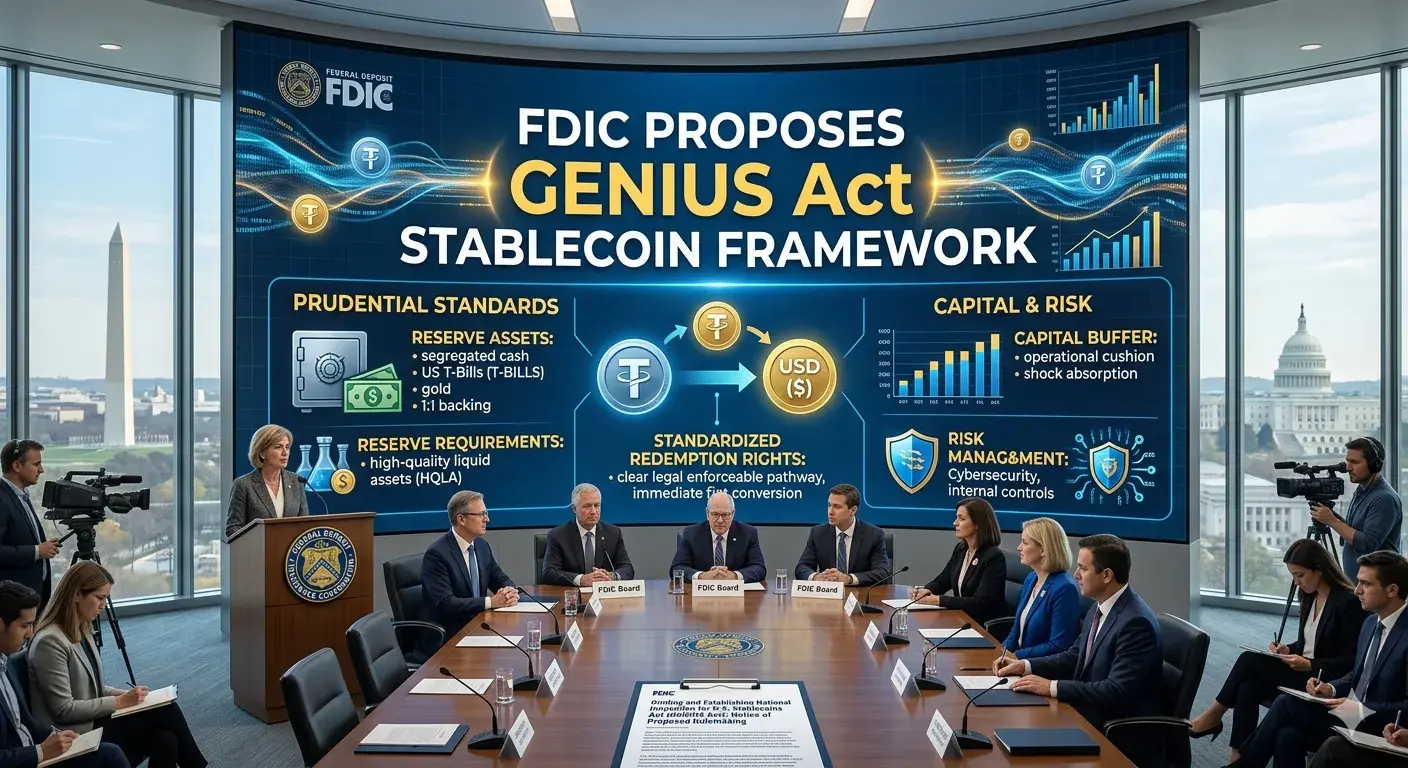
In a landmark decision on April 7, 2026, the Federal Deposit Insurance Corporation (FDIC) Board of Directors approved a notice of proposed rulemaking (NPRM) that signals the most significant shift in digital asset oversight to date. The proposal aims to formalize the GENIUS Act Stablecoin Framework, establishing strict prudential standards for FDIC-supervised issuers of “permitted payment stablecoins.”
This move follows the passage of the Guiding and Establishing National Innovation for U.S. Stablecoins Act (GENIUS Act), a legislative effort designed to bring stablecoin issuers into the regulatory fold of traditional finance while preserving their role in digital commerce.
CRYPTOCAP:TOTAL3 Real-Time Chart
The Four Pillars of the FDIC Proposal
The FDIC isn’t just looking to monitor stablecoins; it is building a “fortress” around the assets that back them. The GENIUS Act Stablecoin Framework focuses on four critical areas to ensure that a “stable” coin remains just that—stable—even during periods of extreme market volatility.
- Reserve Asset Requirements
The 1:1 Mandate
Issuers must hold reserves in highly liquid, low-risk assets such as U.S. Treasury bills or short-term repos. These assets must be held in segregated accounts to ensure they are not commingled with the issuer’s operating funds. - Capital & Liquidity Buffers
Absorbing Shocks
Beyond the 1:1 reserves, issuers must maintain a separate capital buffer. This “rainy day” fund is designed to absorb operational losses or temporary liquidity mismatches without affecting the stablecoin’s peg. - Standardized Redemption Rights
Fiat on Demand
The proposal removes the ambiguity of “best effort” redemptions. It requires issuers to provide a legal guarantee that holders can redeem their tokens for U.S. dollars within a strictly defined timeframe (typically T+1) - Operational Risk & Governance
The Security Layer
This pillar mandates bank-grade cybersecurity standards and internal controls to prevent fraud, mismanagement, and technical failures that could lead to a loss of consumer funds.
Expert Analysis: A Double-Edged Sword?
The introduction of the GENIUS Act Stablecoin Framework has drawn immediate reactions from across the financial and crypto sectors. While many see it as the “green light” for institutional adoption, others fear the cost of compliance could stifle smaller innovators.
 Coinbase and Citi Expand Stablecoin Payments for Businesses→
 XRP Holders Close to Unlocking On-Chain RLUSD Borrowing as Validator Vote Nears Threshold→
 How CFOs Are Transforming Corporate Treasury With Digital Assets, XRP, and RLUSD→
 RLUSD stablecoin and the New Standard for Regulation→
The Institutional Perspective
“The FDIC’s move is essentially a ‘stamp of legitimacy’ for the sector,” says Dr. Aris Varma, Senior Policy Analyst at the Blockchain Finance Institute. “By applying a prudential framework, the FDIC is telling the world that payment stablecoins are now a core component of the U.S. payments system, not just a niche tool for crypto traders.”
The Skeptic’s View
Conversely, some analysts worry about the “moat” this creates for incumbent banks. Sarah Chen, Head of Research at DecentraStream, notes: “The capital and reserve requirements in this GENIUS Act Stablecoin Framework are incredibly high. We might see a consolidation where only the largest, FDIC-insured banks can afford to issue stablecoins, potentially locking out the grassroots innovation that started this space.”
Expert Insight: The FDIC is likely targeting “systemically important” issuers first. This “prudential” approach mirrors the oversight of Global Systemically Important Banks (G-SIBs), focusing on preventing a stablecoin run from spilling over into the broader economy.
What This Means for Investors
For the average user, the GENIUS Act Stablecoin Framework is a win for safety. If an issuer is FDIC-supervised, the risk of a “Terra-style” collapse is virtually eliminated through the mandate for high-quality reserves. However, this safety comes with a trade-off in privacy. To meet these standards, issuers will likely require stricter KYC (Know Your Customer) and AML (Anti-Money Laundering) checks for all redemption activities.
Related: Florida’s New Crypto Law: Regulating Payment Stablecoins in 2026
Next Steps in the Rulemaking Process
The approval of the NPRM is only the beginning. The FDIC has opened a 60-day public comment period, inviting stakeholders—from bank CEOs to DeFi developers—to weigh in on the technical specifics of the GENIUS Act Stablecoin Framework.
- Public Comment Period: Stakeholders submit feedback on reserve types and capital ratios.
- Review & Revision: FDIC staff analyze comments and adjust the rule text.
- Final Board Vote: The FDIC Board votes on the final version of the rule.
- Implementation Phase: Issuers are given a grace period (likely 12–18 months) to bring their operations into full compliance.
Stay informed on the front lines of crypto regulation. Join the CryptoQuorum community for exclusive alerts and deep-dive analysis.