
Key Takeaways
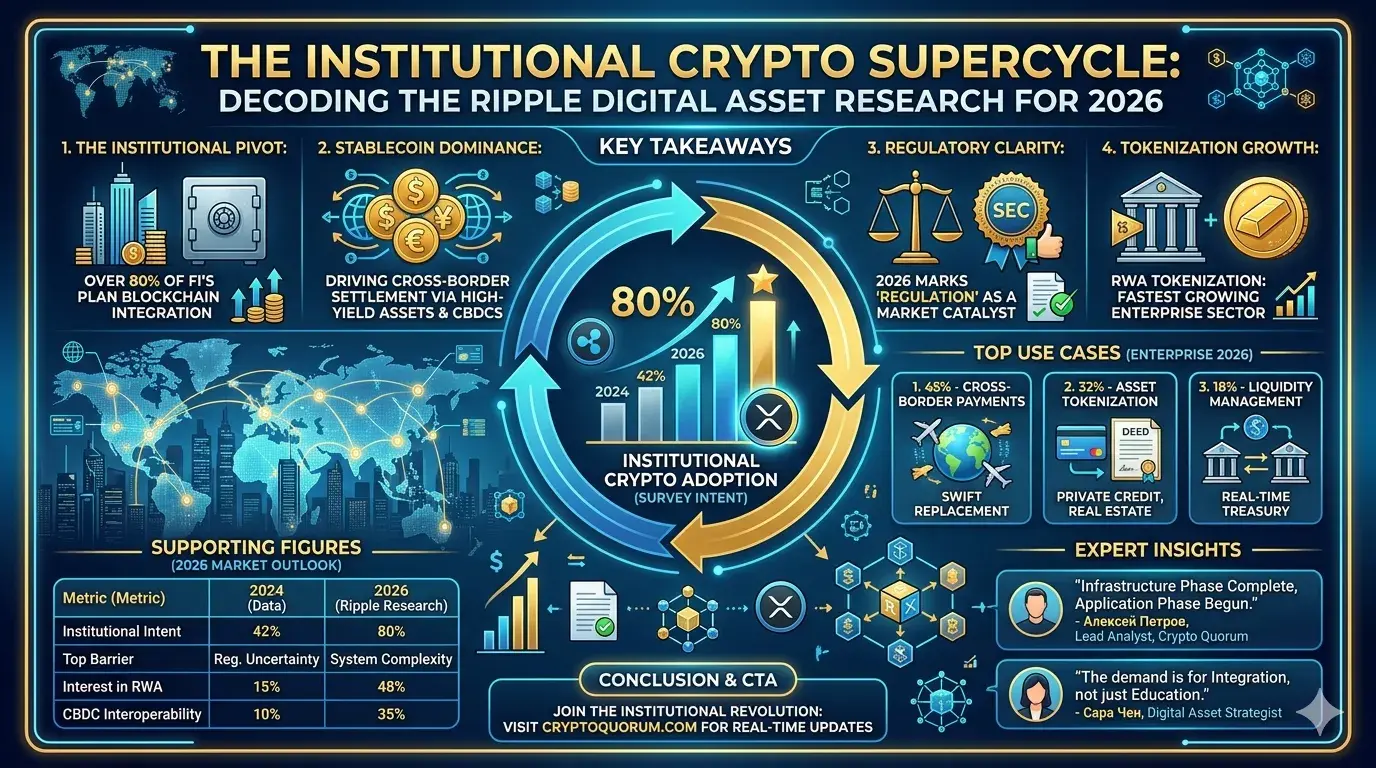
- The Institutional Pivot: Over 80% of financial institutions surveyed plan to integrate blockchain into their operations within the next 24 months.
- Stablecoin Dominance: High-yield stablecoins and Central Bank Digital Currencies (CBDCs) are the primary drivers for cross-border settlement.
- Regulatory Clarity: 2026 marks the first year where “Regulation” is cited as a market catalyst rather than a barrier to entry.
- Tokenization Growth: Real-World Asset (RWA) tokenization is the fastest-growing sector for enterprise-level digital asset deployment.
The narrative surrounding digital finance has undergone a tectonic shift. In the early 2020s, the conversation was dominated by price volatility and speculative retail cycles. However, the release of the latest Ripple digital asset research for 2026 paints a radically different picture—one where the world’s largest financial institutions (FIs) and enterprises have moved from “exploration” to “execution.”
CRYPTOCAP:TOTAL3 Real-Time Chart
According to the comprehensive survey, which polled over 1,500 financial leaders across 30 countries, the global financial system is currently in the midst of an “Institutional Supercycle.” This phase is characterized by the integration of blockchain technology not as a separate asset class, but as the foundational infrastructure for global value transfer.
The 80% Threshold: Why 2026 is the Year of Integration
One of the most striking data points from the Ripple digital asset research is that 80% of financial leaders expect to use some form of digital asset in their business over the next two years. This is a significant jump from the 2024–2025 period, where institutional interest was often hampered by a lack of clear legal frameworks.
 SEC examination priorities put tokenization on 2027→
 Crypto.com Brings Prediction Markets to Institutions→
 IMF Sees Global Growth at 3.1% in 2026 as AI Boom Offsets Energy Shock→
 Morgan Stanley Sees $10T Tokenized Asset Market→
The change can be attributed to the “Regulatory Green Light” seen across major markets. As we have discussed in our analysis of the SEC’s 2026 guidelines, the clarity provided regarding the status of digital commodities has allowed compliance departments to finally approve large-scale blockchain deployments.
Top Use Cases for Enterprises in 2026:
- Cross-Border Payments (45%): Using stablecoins and CBDCs to eliminate the inefficiencies of the legacy SWIFT system.
- Asset Tokenization (32%): Moving private credit, real estate, and treasury bills onto the blockchain for better liquidity.
- Liquidity Management (18%): Using digital assets for real-time treasury operations and inter-bank settlement.
The Rise of the “Settlement Layer”
The 2026 Ripple digital asset research highlights a massive pivot toward “utility-first” tokens. For institutions, the value of a token is no longer derived solely from its price appreciation, but from its efficiency as a settlement layer.
By utilizing smart contracts to automate escrow, identity verification, and tax compliance, banks are reporting a 35% reduction in operational costs. This efficiency is the primary reason why the $XRP Ledger (XRPL) and other high-throughput chains have become the preferred backends for the new digital economy.
Expert Opinions: A Market Transformed
The findings in the Ripple digital asset research have been echoed by top analysts in the field. The consensus is that the “infrastructure phase” of the crypto industry is largely complete, and we have entered the “application phase.”
“This survey confirms what we’ve seen on-chain throughout 2026,” says Alexei Petrov, Lead Analyst at Crypto Quorum. “The barriers that kept big money on the sidelines—security concerns, lack of insurance, and regulatory fog—have been systematically dismantled. We are now seeing a race to see who can tokenized their balance sheet the fastest.”
Sarah Chen, a digital asset strategist for an international investment bank, notes the shift in sentiment regarding cross-border flows:
“In previous years, Ripple’s research often highlighted ‘education’ as the biggest need. Now, the demand is for ‘integration.’ Institutions aren’t asking ‘What is crypto?’ anymore; they are asking ‘How do I plug my legacy API into a stablecoin liquidity pool?'”
Supporting Figures: The Digital Asset Landscape 2026
The survey provides a detailed breakdown of where institutional capital is flowing. While Bitcoin remains the primary treasury reserve asset, the growth in “Functional Assets” is outpacing the broader market.
| Metric | 2024 Survey Data | 2026 Ripple Research |
| Institutional Intent to Use Crypto | 42% | 80% |
| Top Barrier to Entry | Regulatory Uncertainty | System Integration Complexity |
| Interest in Tokenized RWAs | 15% | 48% |
| Focus on CBDC Interoperability | 10% | 35% |
Related: Understanding the Models: How Tokenization and Ownership Records are Redefining Global Finance
The Role of Stablecoins and CBDCs
A core pillar of the Ripple digital asset research is the explosive growth of stablecoins. In 2026, stablecoins are no longer just a “parking spot” for crypto traders; they have become the primary medium of exchange for global trade.
The survey reveals that 65% of enterprises prefer using private stablecoins for B2B transactions, while 35% are looking toward government-backed CBDCs for high-value settlement. The synergy between these two asset types is creating a “hybrid economy” where private innovation and public stability coexist on the same ledger.
Why Stablecoins Won the Payments War:
- Instant Finality: Transactions settle in seconds, not days.
- Programmability: Payments can be programmed to trigger only when certain conditions (like shipping delivery) are met.
- Global Reach: Bypassing the correspondent banking network allows for 24/7/365 operations.
Challenges Remaining: The “Integration Gap”
While the 2026 Ripple digital asset research is overwhelmingly bullish, it does highlight one significant remaining hurdle: the integration gap. Many traditional financial institutions still struggle with the technical requirements of self-custody and blockchain interoperability.
Connecting a 40-year-old COBOL-based banking system to a modern Solana Firedancer validator or an XRPL node is a massive undertaking. Consequently, we are seeing a boom in “Crypto-as-a-Service” providers that act as the middleware for this transition.
The Strategic Importance of Ripple Digital Asset Research
Why does this research matter for the average investor or business owner? It serves as a leading indicator of liquidity. When 80% of financial leaders signal their intent to enter the market, it creates a “liquidity moat” that protects the industry from the boom-and-bust cycles of the past.
The Ripple digital asset research also underscores the importance of the Philosophy of Subtraction—the idea that the most successful blockchains will be the ones that disappear into the background, functioning as invisible plumbing for the global economy.
Conclusion: Preparing for the 2027 Wave
The 2026 survey results make one thing clear: the institutionalization of crypto is no longer a “future event”—it is the current reality. By the time the 2027 survey is released, we expect to see the majority of these “intentions” turned into active, live-market protocols.
For those who have followed the Ripple digital asset research over the years, the message remains consistent: utility is the only sustainable path to value. As the global financial system migrates to the blockchain, those who understand the technical and regulatory nuances of this shift will be the ones who define the next century of finance.
The 2026 market is moving faster than anyone predicted. Stay ahead of the curve with deep-dive technical and regulatory analysis from the experts.