
Key Takeaways
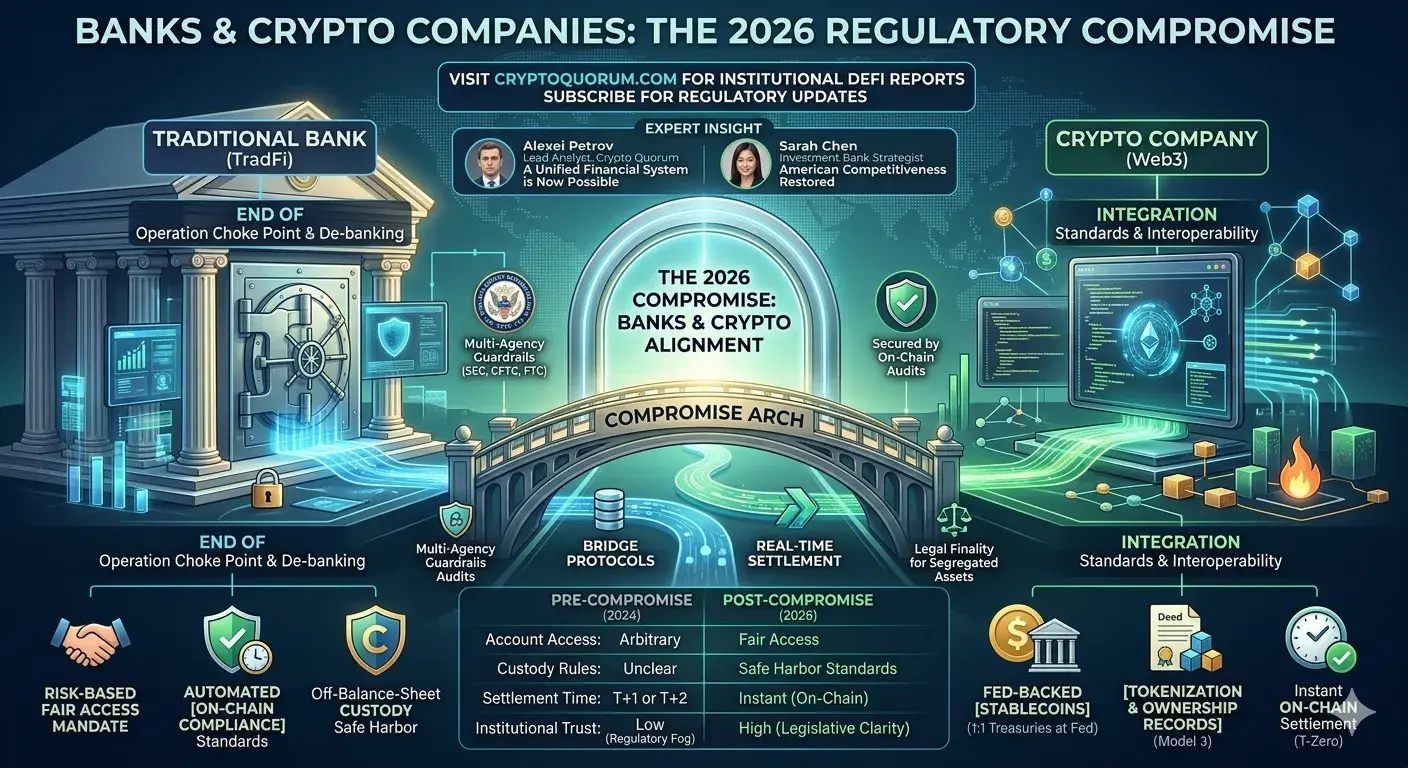
- The Legislative Pivot: New federal guidelines are designed to settle the long-standing friction between traditional finance (TradFi) and the digital asset sector.
- Ending “Choke Point”: The agreement focuses on ending discriminatory de-banking practices against legitimate blockchain enterprises.
- Custodial Clarity: Banks will receive a clear roadmap for holding digital assets, providing a “safe harbor” for institutional participation.
- Interoperability Standards: The compromise introduces shared technical standards for real-time settlement between bank ledgers and public blockchains.
For the better part of a decade, the relationship between the traditional banking sector and the cryptocurrency industry has been characterized by mutual suspicion, legal battles, and the controversial practice of “de-banking.” However, as of March 2026, a significant structural shift is underway. Following high-level negotiations between federal regulators, major banking associations, and leading blockchain innovators, a historic compromise between banks and crypto companies has finally emerged.
CRYPTOCAP:TOTAL Real-Time Chart
This agreement, championed by vocal advocates for digital rights and financial sovereignty, aims to reconcile the stability of the traditional banking system with the efficiency of decentralized protocols. It represents a “truce” that could finally allow the United States to build a unified financial infrastructure for the digital age.
Resolving the De-Banking Crisis
At the heart of this new framework is a definitive end to “Operation Choke Point” tactics. For years, crypto startups struggled to maintain basic business accounts, even when operating with full transparency. The new compromise between banks and crypto companies establishes a “fair access” mandate. Under these rules, banks can no longer terminate services for a client based solely on their involvement in the digital asset sector.
 Ripple, Meritz Bring Tokenization to Korea→
 SEC Sets Compliance Seminar for Nov. 19→
 Ripple Expands Prime Brokerage With Brevan Howard→
 SEC Warns Investors About Investment Scams During World Investor Week→
Instead, the framework introduces a risk-based assessment model. If a crypto company meets specific capital reserve requirements and adheres to automated on-chain compliance standards, banks are encouraged—and in some cases required—to provide them with the same “rails” used by traditional fintech firms.
Banks as the New Custodians of Web3
One of the most transformative elements of the compromise between banks and crypto companies is the formalization of “Digital Asset Custody.” In 2024 and 2025, many banks were hesitant to touch Bitcoin or Ethereum due to unclear balance sheet rules (such as the controversial SAB 121).
The 2026 agreement provides a workaround that allows banks to hold digital assets off-balance-sheet, provided they use approved Tokenization and Ownership Records systems. This allows traditional banks to compete with native crypto custodians, offering a “one-stop-shop” for institutional investors who want to manage their stock portfolios and their crypto holdings under a single roof.
The Benefits of Institutional Custody:
- Enhanced Security: Banks can apply their century-long expertise in vaulting and insurance to digital keys.
- Lowered Barriers: Large pension funds are more likely to enter the market if they can use their existing prime brokerage relationships.
- Legal Finality: The compromise ensures that assets held by banks are legally segregated, protecting investors in the event of a corporate bankruptcy.
Expert Perspectives: A Unified Market
Analysts view this move as the final piece of the puzzle for a 2026 bull market driven by utility rather than speculation.
“We are moving away from the ‘us vs. them’ mentality,” says Alexei Petrov, Lead Analyst at Crypto Quorum. “The compromise between banks and crypto companies recognizes that blockchain is just a better ledger. Once banks stop fearing the tech and start using it, the entire financial system becomes 10x faster and cheaper.”
Sarah Chen, a strategist for a major investment bank, highlights the global implications:
“The U.S. was falling behind regions like the EU and Singapore because our banks were cut off from the crypto world. This compromise between banks and crypto companies restores American competitiveness. It allows our banks to facilitate global cross-border payments using stablecoins while maintaining the safety standards of the Federal Reserve.”
Technical Integration: Bridging the Ledger Gap
The success of the compromise between banks and crypto companies depends on technical interoperability. The agreement mandates the adoption of “Bridge Protocols” that allow a bank’s private ledger to communicate directly with public chains like Ethereum or Solana.
This is where Smart Contracts become essential. By using programmable escrow and real-time settlement, a bank can instantly verify that a crypto company has the collateral it claims to have. This reduces the need for the “trust-based” lending that led to the collapses of 2022 and replaces it with a “verify-based” system.
Comparison: Pre-Compromise vs. Post-Compromise
| Feature | 2024 Environment | 2026 Compromise |
| Account Access | Arbitrary De-banking | Risk-Based Fair Access |
| Custody Rules | Onerous/Unclear | Safe Harbor Standards |
| Settlement Time | T+1 or T+2 | Instant (On-Chain) |
| Institutional Trust | Low (Regulatory Fog) | High (Legislative Clarity) |
The Role of Stablecoins in the New Alliance
Stablecoins are the “glue” holding the compromise between banks and crypto companies together. The agreement creates a clear path for banks to issue their own regulated stablecoins, fully backed 1:1 by U.S. Treasuries held at the Fed.
This move effectively turns stablecoins into a digital extension of the U.S. Dollar, rather than a competitor to it. By embracing this technology, banks can offer their clients the ability to settle trades 24/7/365, bypassing the limitations of the antiquated SWIFT system. This is a core pillar of the Ripple digital asset research that predicted a shift toward utility-based settlement.
Challenges to the “Great Alignment”
While the compromise between banks and crypto companies is a massive leap forward, several challenges remain:
- The Compliance Burden: Smaller crypto startups may struggle to meet the rigorous KYC/AML standards required to partner with Tier-1 banks.
- Technological Debt: Integrating legacy banking mainframes with high-speed Firedancer-powered networks is an expensive and complex undertaking.
- Political Volatility: While the current administration supports the compromise, future shifts in the legislative landscape could still create uncertainty.
Conclusion: A Multi-Trillion Dollar Synergy
The 2026 compromise between banks and crypto companies is the most significant regulatory event of the year. It marks the moment that “Crypto” stopped being a fringe industry and became a core component of the global financial market infrastructure.
By working together, banks and crypto firms can offer a system that combines the best of both worlds: the consumer protections and deep liquidity of the banking system, and the speed, transparency, and programmability of the blockchain. For investors, this means the “regulatory overhang” is finally gone, replaced by a clear, paved road toward mass adoption.
The wall between traditional finance and Web3 is crumbling. Don’t let your portfolio get left behind in the legacy system.